01 Shipped on Steam · Adventure puzzle
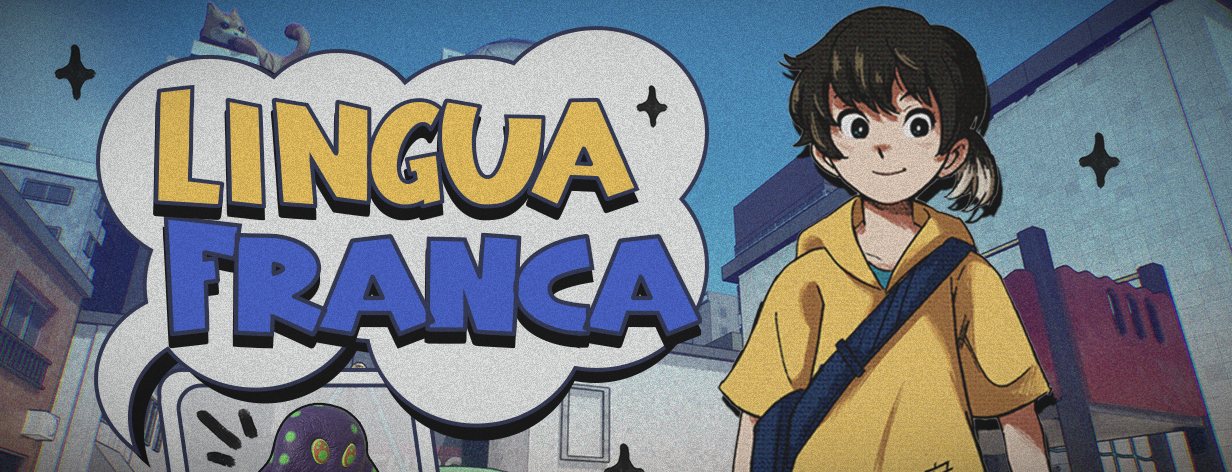
Lingua Franca
A game made by 32 students at the University of Utah and released on Steam. I was designer-producer: I helped keep every department on one design, kept the design work moving in Trello, and took the playtest results into the decision to rebuild the level.
- Role
- Designer-Producer, by phase
- Team
- 32 students · University of Utah
- Timeline
- Aug 2024 – Apr 2025
- Tools
- Trello · Unreal Engine 5
- Release
- Steam · Mar 28, 2025 · free to play · Mostly Positive reviews
I owned
- The design task board in Trello.
- The GDD, co-written with every department's leads.
- Delivery of 33% of the puzzles, with hand-offs to art and engineering through to release.
- Playtest sessions and about 250 feedback reports.
- Meeting documentation to keep departments aligned.
I worked with
- Narrative, on the hint system and dialogue.
- Engineering and art, on tools and assets.
- The vision holder, on authentic Osaka versus playful fantasy.
02 Role by phase
Producing from prototype to gold
The role moved between designer-producer and level designer-producer as the project changed shape.
-
Prototype
From brainstorm to GDD
- Ran brainstorms as game design lead and co-wrote the GDD with every department's leads.
- Created and assigned design tasks in Trello.
- Owned the paper prototypes and early in-engine systems tests.
-
Alpha
Two visions, one paper level
- Bridged the vision holder's authentic Osaka and the design team's push for fantasy.
- Merged the team's ideas into one paper level of suburban Osaka.
- Grey-boxed the first pass, folding in narrative and gameplay requests.
-
Beta
Iterating with feedback
- Owned delivery of 33% of the puzzles, coordinating hand-offs with art and engineering through to release.
- Led the Heart Puzzle design and kept meeting documentation.
- Designed a contextual hint system with the narrative team.
-
Gold
Final refinements
- Ran QA and player playtests.
- Triaged roughly 250 feedback reports.
- Redesigned the level: engagement 3.5 → 8.
Role by phase: Designer-Producer, then Level Designer-Producer, then Designer-Producer again.
03 Alignment
Two visions, one paper level
The vision holder and the design team wanted different things from the game. My part was bridging them: co-writing the GDD with every department's leads and merging the team's ideas into one paper level.
yes, the cat location is in the legend
- TensionThe vision holder wanted an authentic Osaka neighborhood. The design team pushed for playful fantasy.
- What I didBridged the two, merged the team's ideas into one paper level of suburban Osaka, and co-wrote the GDD with every department's leads.
- Kept in syncCreated and assigned design tasks in Trello, and kept meeting documentation so every department worked from the same notes.
04 Playtests and the call
Then the playtests came back
At the University of Utah's Division of Games, the level scored 3.5/10 for engagement. Feedback pointed to confusing layouts and weak signifiers.
Small tweaks only moved the needle slightly, so the team made the call to rework the level drastically: a block grid with stronger landmarks instead of angled Osaka streets.
I oversaw the playtest sessions and triaged about 250 feedback reports.
3.5→8.0
Player engagement after the rework (+128%)
05 Watch
The result, in motion
The official trailer, plus my own walkthrough of the game.