Level select

Level 08Math Apocalypse

01 / 08

01 Serious game · Educational

Math Apocalypse

A quirky wave shooter for third graders. You're a wizard blasting back waves of birds, and the only way to power your attacks is to solve math problems from the grade 3 curriculum.

Role
Game Designer & Producer
Team
3 people
Timeline
May – Jul 2024 · 8 weeks
Built with
Unity 2D · C#

I owned

  • The design brief: zero setup, curriculum-aligned, tension without intimidation.
  • Decay scoring, the streak multiplier and stage progression.
  • Production: Trello, GitHub, standups, playtests and school outreach.

I worked with

  • Engineering: my teammates wrote the C# code.
  • A Salt Lake City teacher, for curriculum fit.
  • An elementary school contact who tested the build.
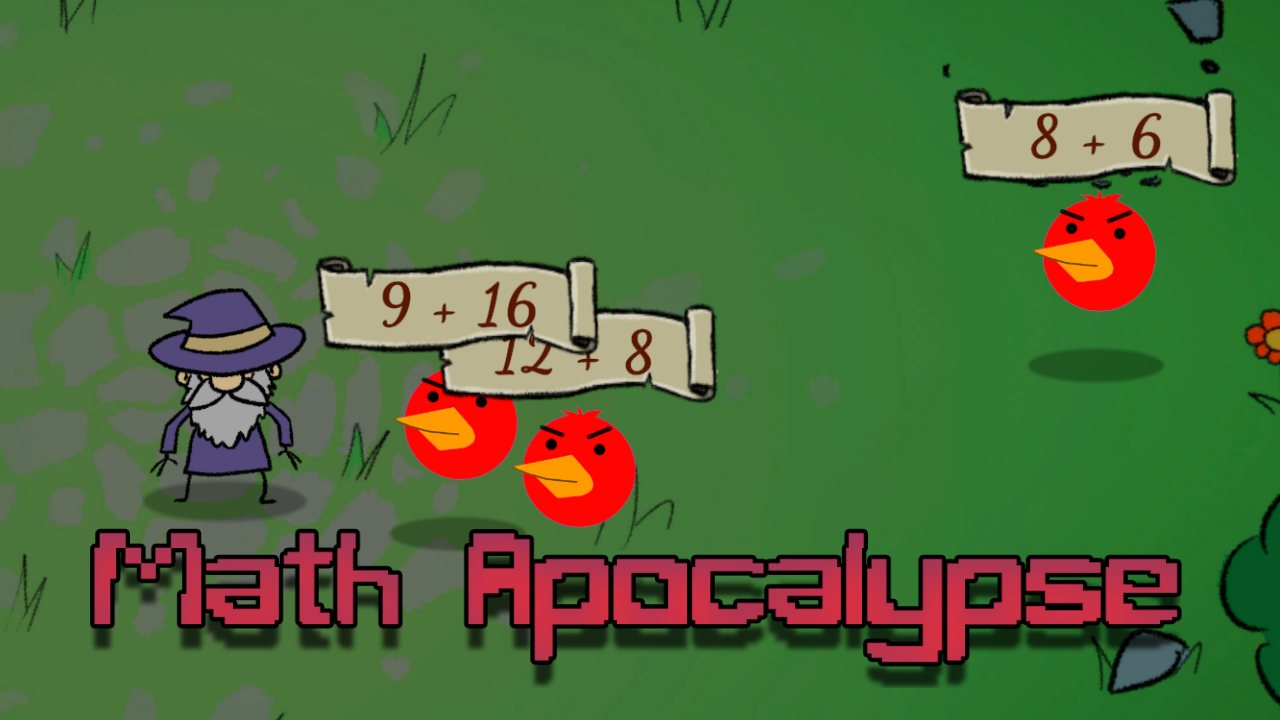
Math Apocalypse title art: a cartoon wizard faces angry red birds carrying math problems on scrolls.

02 Watch

Every equation is part of the action

Get answers right to build multipliers and push into faster, harder waves. Slip up and you lose momentum, and maybe your run.

03 Design goals

A wave shooter, rebuilt for a classroom

The experiment: keep the energy of wave-based combat, but make every attack depend on a correct answer. Fireballs instead of guns, and they only fire when the math is right.

Approachability

Birds, not zombies

Lighthearted birds keep the tension without scaring off younger players.

Curriculum alignment

Real grade 3 math

Problems follow grade 3 standards, checked with a teacher in the Salt Lake City School District.

Low barrier to entry

Drop-in ready

The build works in a classroom with no setup, so teachers can pick it up quickly.

04 Core system

Scoring that rewards speed and accuracy

  • Decay-based scoring: every second a red bird stays alive, its point value drops, which pushes quick decisions.
  • Streak multiplier: doubles after every six correct answers in a row, up to 32×.
  • Forgiving mistakes: a wrong answer halves the multiplier instead of wiping it out, so one slip doesn't kill the fun.

Multiplier

×1

Streak toward next doubling

Answer some problems and watch the multiplier.

05 Progression & stages

Harder math, unlocked over time

StageOperationsScore neededQuick skip
1+ only1,000 ptsNone
2+ −2,500 ptsNone
3+ − ×4,300 ptsKill 3 birds in one attack
4+ − × ÷50,000 ptsNone

Players win back one health point at each new stage. An Endless mode stress-tests mastery with harder problems and faster spawns.

Combat & pacing

Fast, fragile birds apply short-term pressure and test reaction time. Slower, tankier birds build anticipation and force prioritization.

Spawn cooldowns shrink as the score rises, giving a natural difficulty curve.

Feedback systems

Cartoon UI with instant, age-appropriate feedback: a red ✗ flash on wrong answers, stage banners with cooldown windows, and live score and multiplier updates.

06 Creation process

Prototype to classroom

  1. Prototype

    A classroom game with no barrier to entry

    • Designed around the grade 3 curriculum.
    • Consulted a Salt Lake City teacher on classroom needs.
    • Ran production in Trello and GitHub.
  2. Alpha

    Core loop, enemies and look

    • Built scoring on accuracy and speed with a decay mechanic.
    • Designed two non-intimidating enemy types.
    • Made cartoon UI assets and animations.
  3. Beta

    Depth and playtests

    • Added stage progression with more varied problems.
    • Introduced the streak multiplier.
    • Playtested at the U of U Division of Games.
  4. Gold

    Into schools

    • Pitched to a contact in SLC elementary schools and shared a build for teachers to try.
    • Ran QA with detailed bug reports.

07 Production role

Designer and producer on a team of three

I owned design and production; my teammates wrote the C# code. I set up pipelines in Trello and GitHub, broke big tasks into small deliverables, and ran daily standups to keep design, engineering and art aligned. That structure let us iterate fast and fold in feedback from several playtest rounds.

Outcome

Classroom-ready, and actually fun

Math Apocalypse showed how core design principles (feedback loops, pacing, difficulty scaling and reward structures) carry over to educational content.

birds > zombies, for eight-year-olds